If you want a phone that can survive mud, rain, concrete, and a full week off the grid, the Rock series was built exactly for that. The Rock 1 launched in November last year, and barely a month later Blackview followed up with the Rock 2. So this is hardly a true upgrade in the traditional sense. Blackview added a few new features to the Rock 2, but quietly dropped some of the original hardware as well.
Size and Feel
Neither of these phones slips easily into a pocket. The Rock 1 measures 177.9 x 83.5 x 24.7 mm and weighs 490 grams. The Rock 2 is bigger in every way, and its weight climbs to 548 grams.
In terms of protection, both phones perform exactly the same. Each can shrug off dust, high-pressure water jets, and immersion in water up to 1.5 meters deep. On top of that, both offer glove mode, underwater shooting, and a side-mounted fingerprint sensor.
In other words, durability is identical no matter which one you pick. The real differences come down to the screen, performance, and cameras.
Display
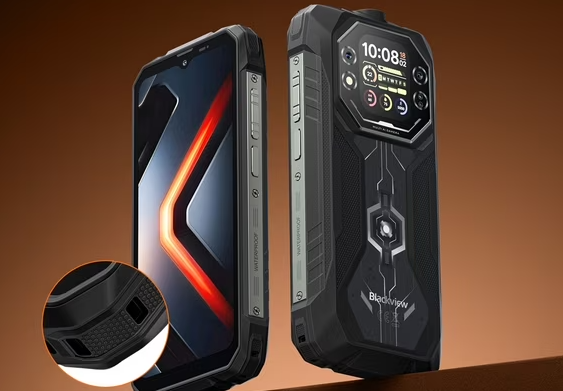
The Rock 1 uses a 6.56-inch HD+ IPS main display, plus a 2.01-inch secondary screen on the back. That rear display is its most distinctive design touch. You can check the time, read notifications, or trigger the flashlight shortcut without ever flipping the phone over.
The Rock 2 drops the second screen but enlarges the main display to 6.67 inches, still an HD+ IPS panel. With the bigger screen, swiping feels smoother and outdoor visibility improves a bit. That said, neither phone has a particularly high pixel density, so do not expect the kind of crispness you get from flagship devices.
If you have a soft spot for the dual-screen design, the Rock 1 is currently the only model in the series that still offers it.
Performance and Connectivity
Performance is where this update actually matters. The Rock 1 runs on a MediaTek Helio G81 built on a 12nm process, paired with either 6GB or 8GB of RAM and 256GB of eMMC 5.1 storage. That setup is enough for map navigation, WhatsApp, and some lightweight apps, but it only supports 4G networks.
The Rock 2 upgrades to a UNISOC T8100 built on a 6nm process, with RAM bumped up to 8GB or 12GB and storage swapped for the faster-responding UFS 2.2. In everyday use, apps open noticeably faster, read and write operations feel smoother, and it adds support for 5G networks. If you regularly rely on mobile networks to transfer files in the field, this difference will directly affect your experience.
Cameras
The two models take different paths on cameras. The Rock 1 pairs a 16-megapixel main camera with a 20-megapixel night vision camera, plus a 13-megapixel front camera. That night vision lens is its core selling point for outdoor use, ideal for dark trails, campsites, and job sites after sunset.
The Rock 2 also has a 16-megapixel main camera and a 13-megapixel front camera, but next to the main shooter it keeps only a single auxiliary camera, with no dedicated night vision module. In bright daylight, photo quality from the two phones is close. Once the light drops, the Rock 1, with its dedicated night vision hardware, still holds a real advantage in specific situations.
Battery and Endurance
Battery life is nearly a tie. Both phones pack a massive 15000mAh battery and support 33W wired fast charging along with 5W reverse charging. Whether you are topping up the phone itself or lending power to another device in a pinch, the setup is exactly the same.
Endurance still differs slightly. The Rock 1 has a smaller, dimmer screen with a 90Hz refresh rate, so it lasts a bit longer in lab testing. The Rock 2, with its 120Hz high-refresh display and 5G modem, consumes more power overall and falls a little short. Given the identical battery capacity, that gap is not dramatic in real-world use.
Which One Is Right for You?
Taking everything into account, each phone has a clear audience.
If you want a rear display, night vision, a slightly smaller body that is easier to hold, and you have no need for 5G, the Rock 1 is the better fit. Its overall specs are hardly aggressive, but the combination of features has more personality, and it stands out as the unique one in the series.
If you care more about 5G connectivity, a brighter 120Hz screen, faster storage, and more RAM, go with the Rock 2. The trade-offs you accept are a larger, heavier body, plus the loss of the secondary display and the night vision camera.